

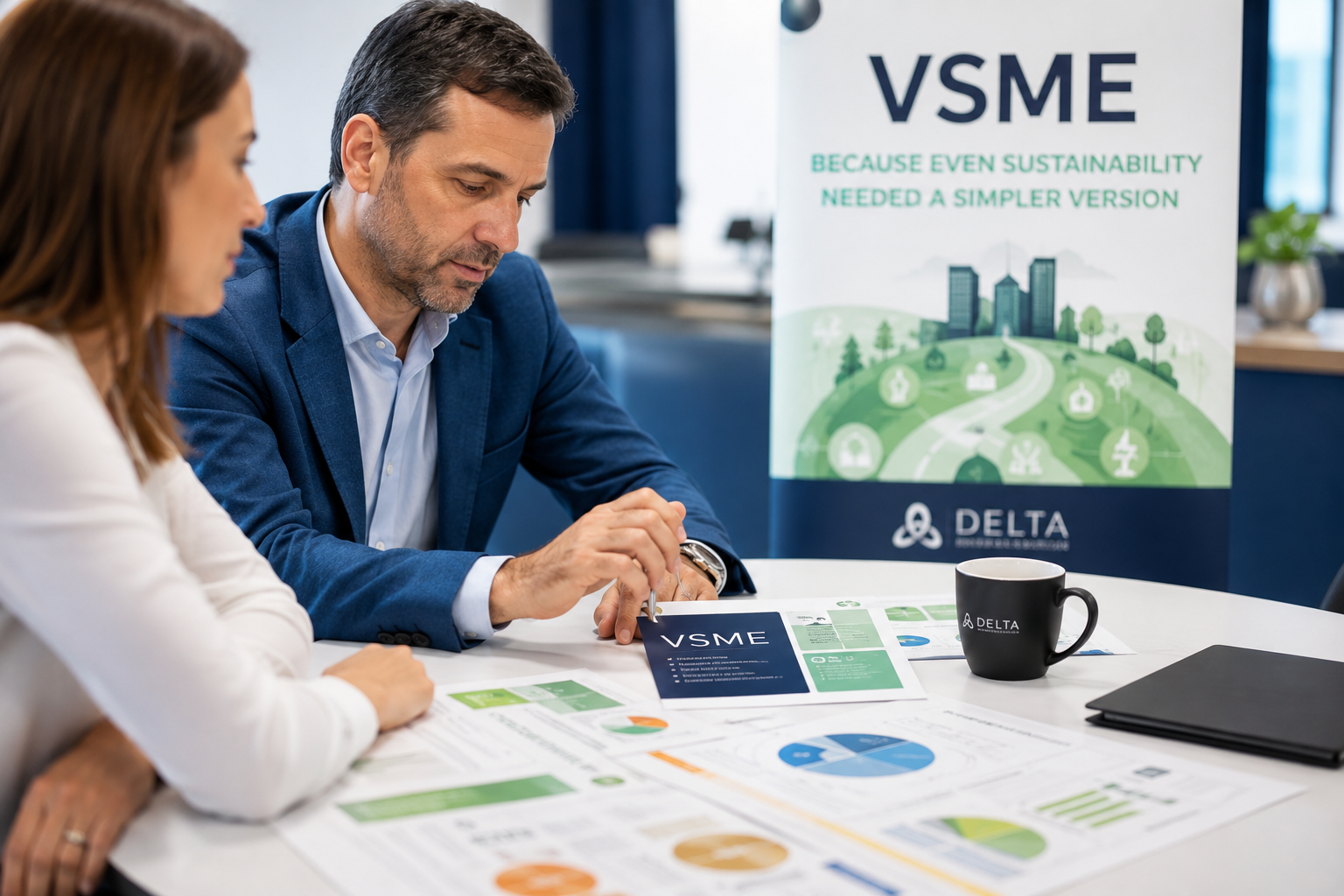
Today, we are discussing the VSME (Voluntary Sustainability Reporting Standard for non-listed SMEs). It is a voluntary European sustainability reporting standard designed to help micro-enterprises as well as small and medium-sized non-listed companies better understand, structure, and communicate their environmental, social, and governance (ESG) impacts. The standard was developed by EFRAG with the aim of promoting sustainability, strengthening transparency, and providing a simplified and proportionate framework tailored to the reality of SMEs.
In practical terms, the VSME enables companies to provide stakeholders, investors, and business partners with useful information that can support decision-making. It also serves as a tool to improve sustainable business performance by integrating environmental, social, and governance factors into company management. More broadly, it helps SMEs contribute to a more responsible, resilient, and sustainability-oriented economy.
Although the standard is entirely voluntary, it is built around two reporting levels: the Basic Module and the Comprehensive Module. The Basic Module forms the minimum reporting foundation. It includes 11 disclosures (B1 to B11), covering general company information, policies and practices, and key environmental, social, and governance indicators. More specifically, disclosures B1 and B2 focus on general information and on sustainability-related policies and practices. Disclosures B3 to B7 address issues such as energy consumption, greenhouse gas emissions, resource use, and broader environmental matters. Disclosures B8 to B10 relate to social aspects, including working conditions and workforce-related matters. Finally, disclosure B11 concerns governance, with particular attention to corruption-related issues.
The Comprehensive Module expands on this first level by adding 9 additional disclosures. It introduces more qualitative and narrative information, particularly regarding practices, policies, future initiatives, company objectives, and other advanced elements that are often requested by banks, investors, and value-chain partners. It therefore allows companies to go further in structuring and strengthening the credibility of their ESG reporting.
Even though the VSME remains voluntary, its use is based on a defined reference framework. For micro-enterprises, for instance, the category is assessed against three thresholds: €450,000 in balance sheet total, €900,000 in net turnover, and an average of 10 employees during the financial year. A company is considered micro if it does not exceed two of these three thresholds. Equivalent frameworks also exist for small and medium-sized undertakings.
This standard represents a real opportunity. It prepares companies and their leaders to operate in an economy where sustainability is becoming a common language, a factor of credibility, and a strategic management tool. The VSME is not only a reporting framework; it is also a tool for awareness, risk management, and continuous adjustment. In that sense, it can support business growth while placing the company on a more solid, more transparent, and more sustainable path.
Articolo di Carlos Lougourou, Sustainability Advisor
