

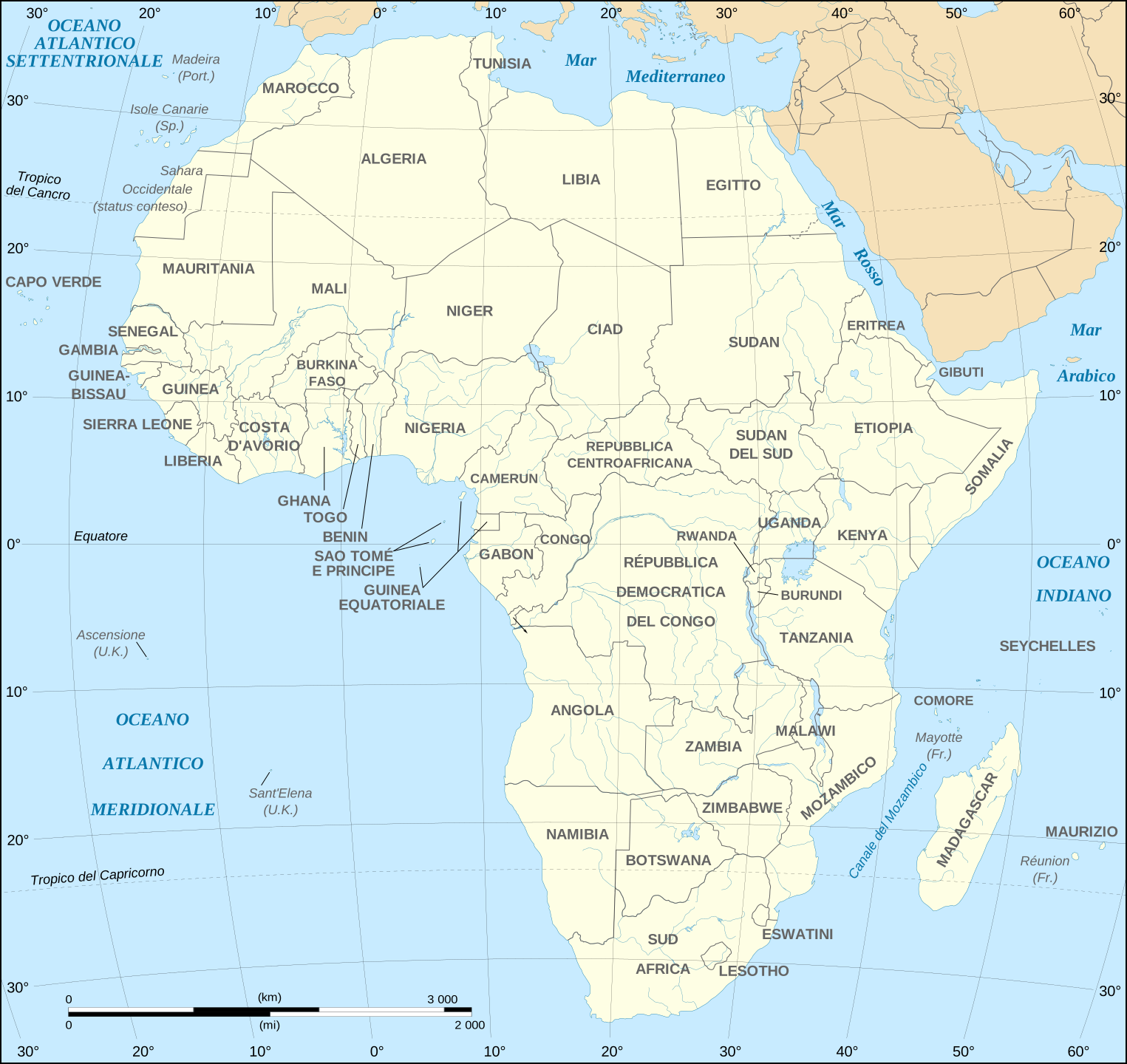
In Africa, SMEs are not a marginal economic category. They are the beating heart of the continent. According to estimates from the African Development Bank, nearly 90% of African businesses are small and medium-sized enterprises. They generate more than 40% of Africa’s GDP and, in some countries, account for up to 60% of formal employment.
In other words, when we talk about African growth, employment, investment, innovation or local development, we are first and foremost talking about SMEs. Even when major conferences prefer to focus on unicorns, investment funds or highly inspired speeches about “the Africa of tomorrow”.
Governments have understood this very well. Africa’s economic environment is attracting more and more investors, and several States are multiplying incentives in favour of SMEs. Ghana, for example, launched the YouStart programme in 2022, with the ambition of financing more than 1 million SMEs by 2030. In South Africa, SMEs are estimated to represent around 60% of formal employment and to contribute nearly 34% of national GDP. Added to this is the African Continental Free Trade Area, which theoretically opens a market of more than 1.3 billion consumers to African SMEs, with a dynamic that could significantly increase intra-African trade by 2030.
On paper, everything seems to be in place: entrepreneurs, markets, needs, investors, public policies and consumers. Africa is building, selling, exporting, innovating and attracting capital. But, as often happens, paper is very generous. Reality is slightly less romantic. Creating an SME is one thing. Making it last is another. And making it survive its founder can sometimes feel like a strategic miracle.
In Africa’s private sector, around 70% of SMEs are family businesses. This means that a large share of the economic fabric relies on structures where ownership, management, authority and family emotions are often deeply intertwined.
The founder is usually at the centre of everything. He knows the suppliers, reassures the banks, makes hiring decisions, manages conflicts, negotiates contracts, speaks to key clients, arbitrates family disagreements and, sometimes, even chooses the colour of the logo. As long as he is there, the company moves forward. Not always in a perfectly organised way, but it moves forward.
The problem is that the founder is not a business model. He is a person.
And, until proven otherwise, even the most charismatic founder has not yet found a way to remain eternally CEO, family referee, moral banker and living memory of the company.
International figures on family businesses are well known, and they should be taken seriously. According to data often cited by the Family Business Institute, only 30% of family businesses successfully transition to the second generation. Barely 12% survive to the third generation.
These figures are worrying everywhere. But they are even more worrying in Africa, where the economy depends heavily on family-owned SMEs. If these businesses fail to organise their succession, it is not only one family losing its wealth. It is an entire economic fabric becoming more fragile. The paradox is striking. Many African entrepreneurs are excellent at creating wealth. They know how to identify an opportunity, enter a market, negotiate in complex environments, resist crises, deal with administrative constraints, navigate informality and turn an intuition into a profitable activity.
The problem often lies in the absence of a long-term strategic vision that treats generational transition as a vital element of the company’s future. The long term is mentioned, sometimes even celebrated, but rarely organised. People talk about vision, growth, development and legacy. Then, when it is time to draft a family charter, define a succession plan, separate the roles of shareholder and manager or bring independent directors into the boardroom, enthusiasm suddenly becomes much more discreet. It is less glamorous than a speech about entrepreneurship. But it is far more useful.
According to a PwC study often cited on the subject, fewer than 15% of African family businesses have a formalised succession plan. If we consider that nearly 70% of private-sector SMEs are family businesses, this leaves a very large number of companies exposed to a major risk at the moment of transmission. In other words, many African businesses are built to succeed under the authority of the founder, but not necessarily to survive his absence.
The first reason is simple: succession is often neglected. Sometimes out of ignorance. Sometimes out of modesty. Sometimes out of fear of opening conflicts. And sometimes because some founders still confuse control with continuity. In many family businesses, talking about succession means touching a sensitive subject. It forces people to ask questions nobody really wants to ask: who is competent? Who is legitimate? Who is a shareholder? Who can actually manage the company? Who should stay out of day-to-day operations? How can heirs be treated fairly without destroying the efficiency of the business?
In short, all the things a family often prefers to avoid for twenty years, until everyone discovers that silence was not a strategy. It was simply a postponed problem with compound interest.
Some companies remain focused on short-term gain. They invest in stock, machines, offices, cars, commercial relationships and sometimes even very nice motivational seminars. But they do not invest in what truly allows the company to cross generations: governance.
Without clear governance, the family can become the company’s first risk factor. This risk is particularly visible in the case of Tuskys Supermarkets in Kenya.
Founded by Joram Kamau, Tuskys became one of the leading retail chains in East Africa. It was a real African family business success story: rapid growth, strong visibility, major presence in the Kenyan and regional retail market. But after the founder’s death in 2002, the transfer of power to his heirs was not accompanied by sufficiently clear, independent and professionalised governance. Several family members found themselves acting at the same time as shareholders, managers, heirs and judges of their own disagreements.
Rivalries between brothers, accusations of mismanagement, the absence of genuine external arbitration and blockages around opening the company’s capital gradually weakened the business. Tuskys did not only suffer from competition, debt or market pressure. It revealed a deeper weakness: the inability to transform a family entrepreneurial success into a sustainable institution.
The lesson is clear: a family business can be powerful while the founder is alive. But it becomes truly solid only when it can function without him. That is the real difference between an emotional family business and a governed family business.
Studies show that family businesses which manage to last are generally those that put in place precise mechanisms: a board of directors with independent members, a written family charter, a formalised succession plan, and a clear separation between the roles of shareholder, family member and manager.
In other words, they understand that governance is not institutional decoration. It is not a document designed to please consultants. Nor is it a luxury reserved for large listed companies. Governance is a strategic life insurance policy.
This is where the Italian model can offer an interesting source of inspiration.
Italy is often cited as one of Europe’s great models of intergenerational transmission, mainly because of the historical predominance of its family-owned SMEs, which represent around 83% of Italian businesses. This model rests on several elements: the preservation of know-how, territorial roots, continuity of family capital, and also a legal and cultural environment that supports the organised transfer of businesses.
One of the most interesting instruments is the family pact, introduced into Italian civil law. It allows an entrepreneur to anticipate the transfer of the business or company shares to one or more descendants, in order to prevent succession from turning into a patrimonial battlefield.
There is also an incentive-based tax framework. Unlike in some other European countries, Italian legislation provides, under certain conditions, a full exemption from inheritance or gift tax when a business is transferred to a spouse or descendants and they commit to continuing the activity. The message is strong: a family business should not die simply because it changes generation.
But the Italian model is not based only on law or taxation. It is also based on a culture of transmission. In many Italian family-owned SMEs, younger generations are gradually integrated into the business, trained in the trade, exposed to foreign markets and sometimes sent abroad to open new commercial opportunities.
Tradition is therefore not opposed to innovation. It becomes a foundation. “Made in Italy” has not survived because it stared nostalgically at its past. It has survived because it learned, with varying degrees of success, to turn heritage into strategy.
Of course, this does not mean Africa should copy Italy. No model can be mechanically transplanted from one continent to another. And before someone rushes to write the usual comment, “the realities are not the same”, let us say it clearly: yes, the realities are not the same.
But being inspired is not the same as copying.
The challenge for African economies is to build their own models of transmission, adapted to local realities, family structures, legal systems, fiscal constraints, cultural practices and business needs.
But one thing seems difficult to dispute: without a succession plan, without clear governance, without a separation of roles and without mechanisms to resolve conflicts, many family businesses will remain vulnerable precisely at the moment when they should become stronger. Africa needs SMEs that are born. But above all, it needs SMEs that last. It needs visionary founders, yes. But it also needs boards of directors, family pacts, charters, succession plans and rules capable of protecting businesses from internal conflict.
When a family business disappears, it is not only heirs who lose wealth. Jobs become fragile. Suppliers lose a client. Banks lose a partner. Territories lose an economic actor. Consumers lose a trusted brand. Generational transition must therefore no longer be treated as a private matter, postponed until it is too late to discuss it calmly. It must become a central issue of governance, competitiveness and African economic development. Ultimately, the true success of a family entrepreneur is not measured only by the size of the company built during his lifetime. It is measured by what remains when he is no longer there.
References
- African Development Bank. SMEs and Trade Finance in Africa. African Development Bank, 2021.
- Government of Ghana, Ministry of Finance. Policy Paper on the YouStart Programme, 2022.
- Family Business Institute. Family Business Succession Statistics: Transition to the Second and Third Generation.
- PwC. Africa Family Business Survey / Strengthening Family Businesses. PwC, 2021–2024.
- Cliffe Dekker Hofmeyr. Liquidation of Tuskys Supermarket: A Case of Too Little Too Late, 2023.
Articolo di Carlos Lougourou, Sustainability Advisor
